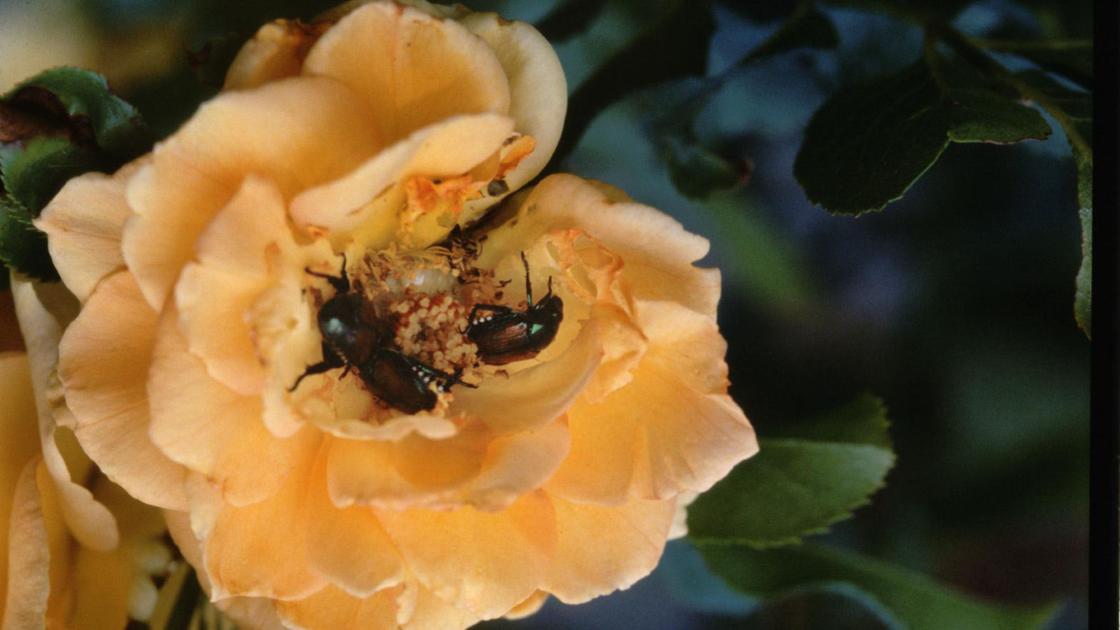
Q: The Japanese beetles are destroying my okra leaves. Are there organic treatments for Japanese beetles?
Answer: Japanese beetles feed on over 300 different plants and seem to appear out of nowhere. You can recognize their damage as large holes in a leaf and will usually skeletonize the leaves on your plants. Gardeners often see the beetles feeding as groups early to midday on warm, sunny days in late June and July. The beetles emerge from the ground at this time of year and have a voracious appetite after overwintering as larvae in the soil. There is usually one generation each year. After the adult beetles fly around and feed in late June and July, the females will lay white spherical eggs in the soil in August. The larva hatch and feed on roots until the soil temperatures cool. At this point, the larvae move to a soil depth of about 8 inches to overwinter. The warming soil triggers the larvae to complete metamorphosis and emerge from the soil in the early summer to feed and repeat the life cycle. Organic treatments can be used at different stages of the Japanese beetle’s life cycle. In August, beneficial nematodes and Neem Oil can be used as a soil drench to attack the young, active larvae. In the spring of the year before beetle emergence, spray a kaolin clay protectant on the okra leaves. The clay product will make the leaves less desirable for munching by the beetles. Once the beetles emerge and start eating the leaves, you can use Neem Oil or pyrethrins as a spray for control. Always follow the label instructions and avoid spraying beneficial insects. For more information about Japanese beetles, check out this Extension publication at https://go.ncsu.edu/japbeetles.
Q: How do I control corn earworms in my sweet corn? Last year, almost every ear had worms in them when I harvested.
Answer: Corn earworm can be controlled with regular sprays of insecticides on the silks as they form on the corn. The moths lay the eggs on the silks so, if the silks are treated regularly, you can control the problem. Applications of an insecticide every two to three days will be necessary. The moths fly in late June and the month of July. There is a three-week period from silking to harvest but only a two-week period from when the silks appear and when they begin to dry. Because moths prefer juicy silks and shy away from the dry ones, the insecticide is only needed the first two weeks of silking. There are a number of products that are effective against corn earworm. Many people prefer an organic treatment, such as mineral oil or other light horticultural oil. With this method, the oil is placed inside the silk end of the ear with a medicine dropper (½ to ¾ of a dropper) after the silks turn brown. This will coat the earworms present and likely suffocate them. Short intervals are necessary when using sprays. Spinosad (SpinTor, Conserve) is an organic product that will work, or you can try one of the other products labeled for the corn ear worm such as cyfluthrin (Baythroid; Bayer Powerforce Multi-insect killer).
July 03, 2020 at 10:00AM
https://ift.tt/31BAjgN
Extension: Japanese beetles can do a lot of damage to leaves of okra and other plants - Winston-Salem Journal
https://ift.tt/3hPCl2f
okra


No comments:
Post a Comment